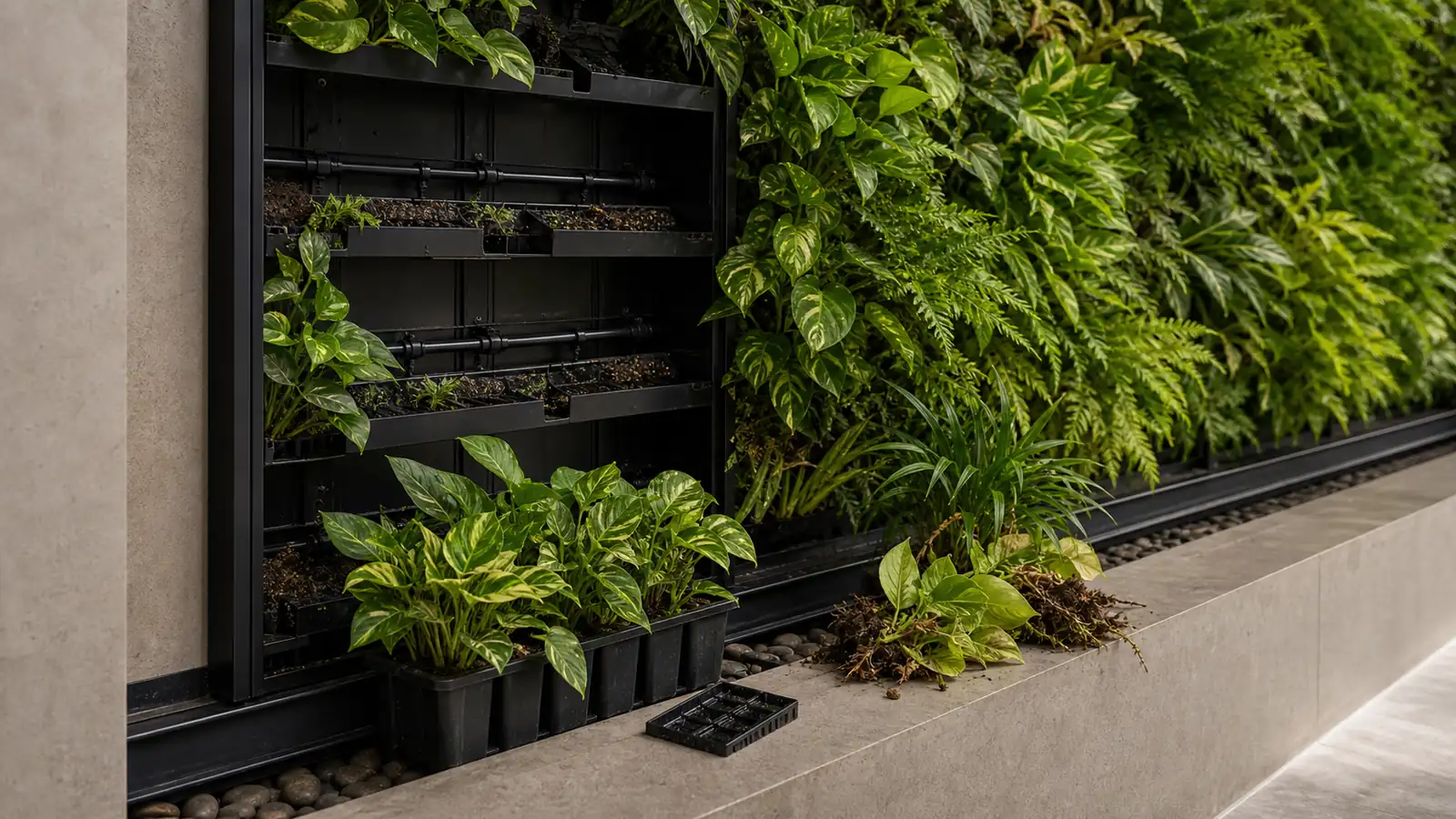
A living wall develops a few weaker groups over time. Harsh sun, low light, a blocked emitter, or an aging plant can affect one zone before the rest. Watch each group for signs of decline instead of applying one replacement date to every project.
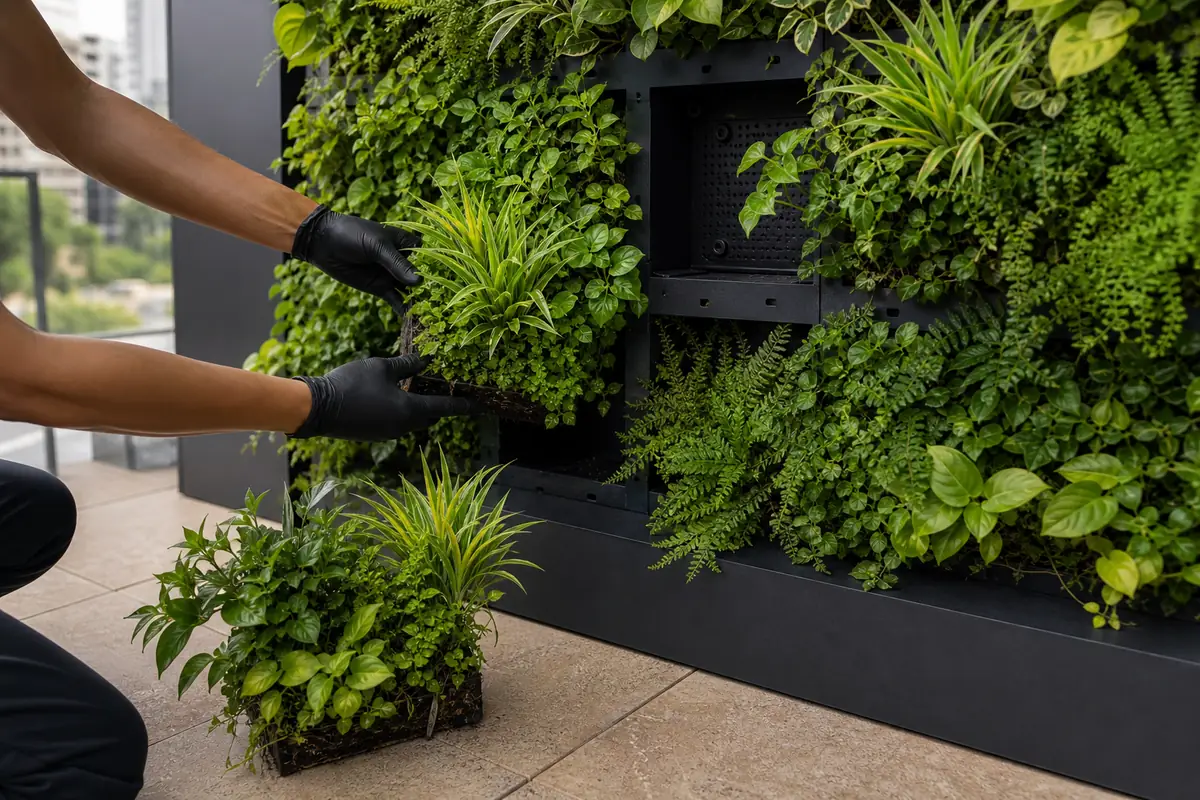
Replace Plants by the Pattern of Decline
Replacement works best when the wall has a care history and the technician knows which zones weaken. One yellow plant may be adjusting to the environment; a yellow band often points to light or water. Replacing the plant without correcting the cause repeats the fault.
Plants on the same wall do not age at the same rate. A sunny edge and a corner under air-conditioning have different operating conditions.
The First Month Is an Adjustment Period
During the first month, plants move from a nursery to a vertical surface, from daylight to supplemental lighting, or from open air to air-conditioning. A few weak plants may need early replacement to keep the wall dense. That does not mean the whole system has failed.
Durable plant groups reduce replacement, but they still react when the position is wrong. They need suitable light, water, and an open root zone.
Plant Life Depends on Living Conditions
Plant life on a wall depends more on the environment than on a species label. With even water and suitable light, foliage can hold its form for a long time. In the wrong zone, it declines quickly. Modules allow local replacement without opening the whole surface.
Record replacement zones during care visits. After several months, the team can see where a species should change or irrigation needs adjustment.
Maintenance Reduces Replacement
Care should inspect roots, leaves, water, and planting density. When a plant weakens, the technician decides whether to prune for recovery, move it, or replace it. Waiting too long leaves a visible gap; replacing too early creates unnecessary cost.
Correct the cause, whether it is an emitter, light, growing medium, or hot airflow.
Replacement Risk Is Front-Loaded
Tường Cây SG divides maintenance into establishment, routine and ongoing phases; the establishment phase can run one to two years depending on the project. In field work, plant position on the wall also changes growth: upper, middle and lower rows do not develop alike within one system. Taken together: replacement clusters into the early period rather than spreading evenly across the years, and a weak cluster usually points to a system fault rather than to plants reaching the end of their life.
When to Replace Plants, When to Fix the Cause
| One weak plant | Check light and emitter around that spot before replacing. |
|---|---|
| Weak vertical band | Fix the irrigation zone or hot airflow first, or the fault repeats. |
| Aging or misshapen cluster | Replace by cluster to keep coverage and color even. |
| Decline after replacement | Read medium, water and plant position again. |
Frequently Asked Questions
Does the entire wall need replacement?
No. A well-designed system allows the technician to replace weak groups and keep the healthy surface.
Does plant replacement take a long time?
It depends on height and the number of groups. Removable modules make the work faster than a fully concealed system.
How long is the plant warranty?
It depends on the agreed scope and operating conditions. Read the warranty period, care requirements, and exclusions stated in the contract.
What We’ve Already Worked Out
The worry: nobody can say in advance how many plants your wall will lose, so the annual cost stays open-ended.
What we fixed in advance: replacement by condition rather than by fixed schedule, with a replacement allowance paid up front inside the package instead of billed each time. The risk sits in the first year, so the packages are graded by how long we stay beside the wall during it.
Which package covers it: Verdant — three months of maintenance and one replacement round up to 15%. Evergreen — twelve months and three rounds up to 20%. Standard includes no maintenance, which suits owners caring for the wall themselves.
What still needs a look: a west-facing balcony under hard afternoon sun needs a different plant list within the same concept. That changes the plants, not the package price.