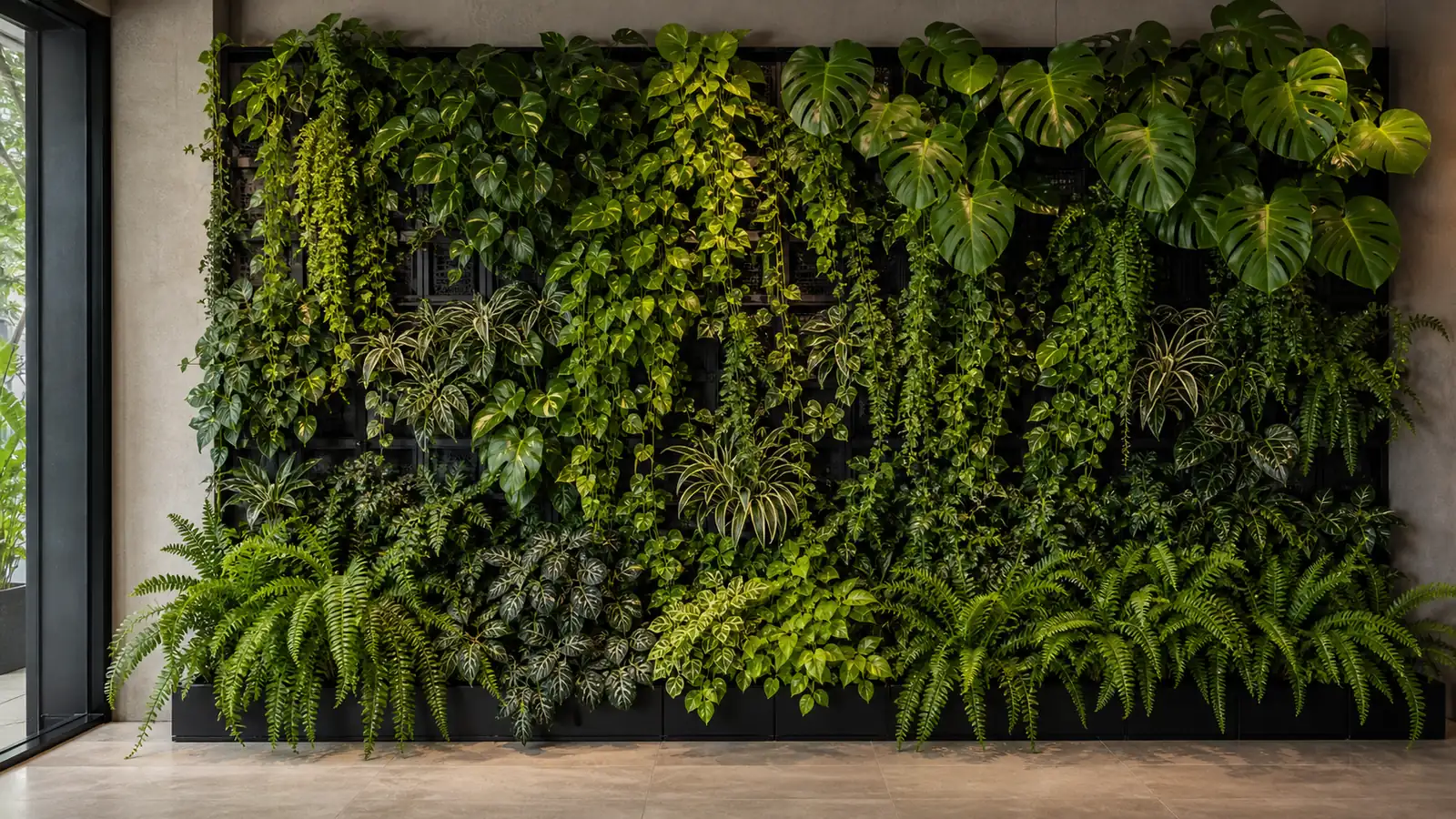
A planted wall has depth because leaf layers perform different jobs. Background plants hold the color, trailing plants soften the edge, and accent plants give the eye a place to stop. Divide plants by layer instead of collecting a long list and repeating it evenly from top to bottom.
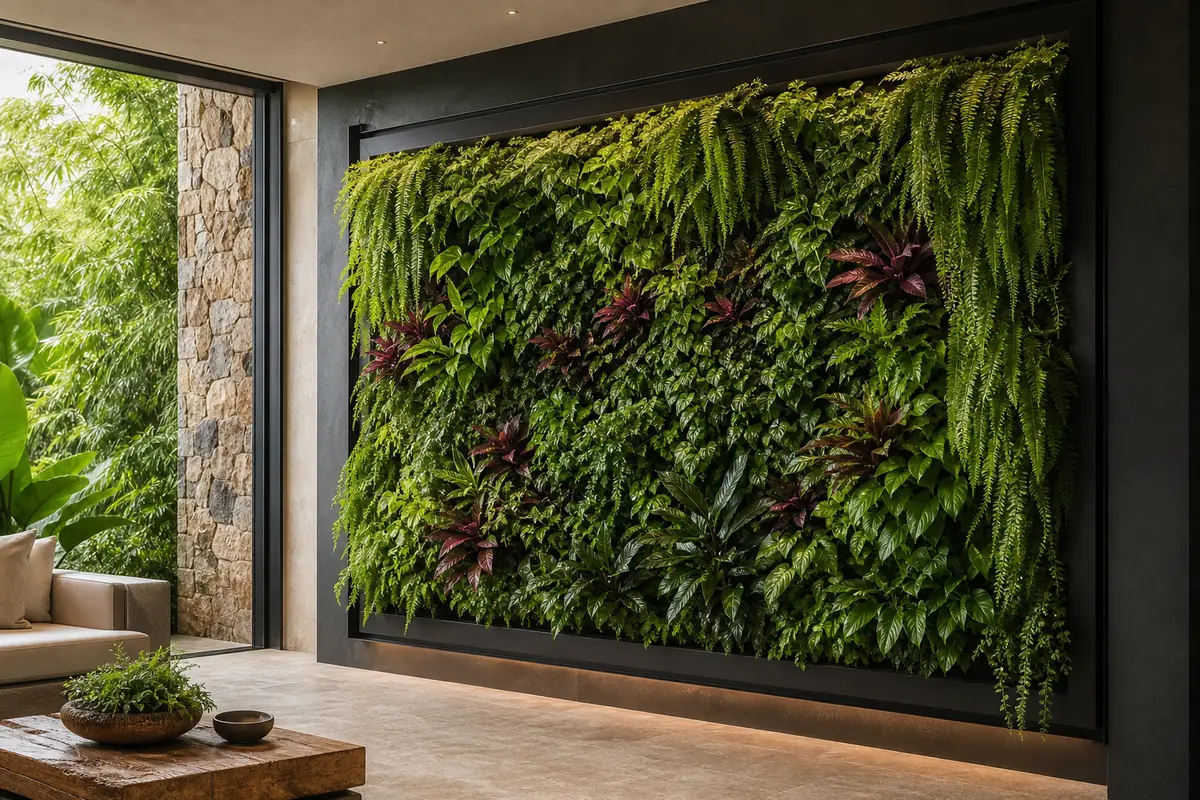
Background Layer: Pothos, Ferns, and Soft Foliage
The background should cover steadily without competing for attention. Pothos and ferns often work here because their softer foliage connects gaps and suits many indoor walls. A stable background gives accent plants room to read clearly.
Background plants also need to tolerate routine pruning. Fast growth increases care and quickly distorts the composition.
Trailing Layer: Moderate Growth at the Frame Edge
Trailing foliage sits along frame edges, beneath module rows, and across small gaps. Use it with restraint so the wall does not appear visually heavy at the bottom. Near the floor, keep it away from circulation and from positions where children can pull it.
Plants with moderate growth, limited leaf drop, and tolerance for light pruning suit this layer. Low-maintenance never means no maintenance.
Accent Layer: Larger Leaves and Stronger Light
Larger leaves provide a visual anchor when the wall is viewed from a distance. Group them rather than distributing them evenly so the eye has pauses. In a small living room, too many large leaves can make the wall feel heavy and crowd the furniture.
Reserve sun-tolerant plants for bright zones, balcony edges, and direct light. In a dark corner, they lose form.
Balance the Three Layers in a Living Wall
The background fills the plane, accents create rhythm, and trailing foliage softens the boundary. When the three layers balance, the wall feels composed without needing many species.
A successful living wall remains viable over time. The exact species can change with the light and wind of the position, as long as each layer keeps a clear role.
Where Each Layer Actually Sits
Tường Cây SG assigns each layer by the living limits of the plant, not by the name alone. Boston fern wants indirect light, a substrate that stays moist but drains, and relatively high air humidity, so leaf tips brown in dry positions. Philodendron hederaceum tolerates low light and trails well, but soil kept too wet causes root rot. Aglaonema prefers diffused light and free-draining substrate, and should stay out of direct sun. Layer roles only hold when the position suits the plant.
Plant Layers Inside the Wall
| Base layer | Use stable foliage to hold coverage and the main green field. |
|---|---|
| Trailing layer | Place along edges or upper rows to soften the frame. |
| Accent layer | Use sparingly in clusters for color or leaf-shape rhythm. |
| Light layer | Separate stronger-light and lower-light zones inside the plant list. |
Frequently Asked Questions
Should a green wall use many species?
No. Fewer species placed in the right layer and light often create a calmer surface.
Do low-maintenance plants really exist?
Some groups stabilize more easily, but all need water, light, and pruning. The wrong position can turn a durable plant into a difficult one.
Can the plant list change with the season?
Yes. With a care schedule, a technician can replace a few groups for hot weather, the wet season, or changing light.
What We’ve Already Worked Out
The worry: not knowing which plants belong in the base, trailing and accent layers.
What we fixed in advance: the layering is decided by role and by light zone, inside one Tropical concept. You do not select individual species.
Which package covers it: all three decor packages — Standard 2m² 12,500,000đ, Verdant 4m² 28,500,000đ, Evergreen 4m² 43,500,000đ, all on the same Tropical planting system.
What still needs a look: strong wind or salt air narrows the plant list considerably. We look at photographs of that kind of position before confirming a schedule.