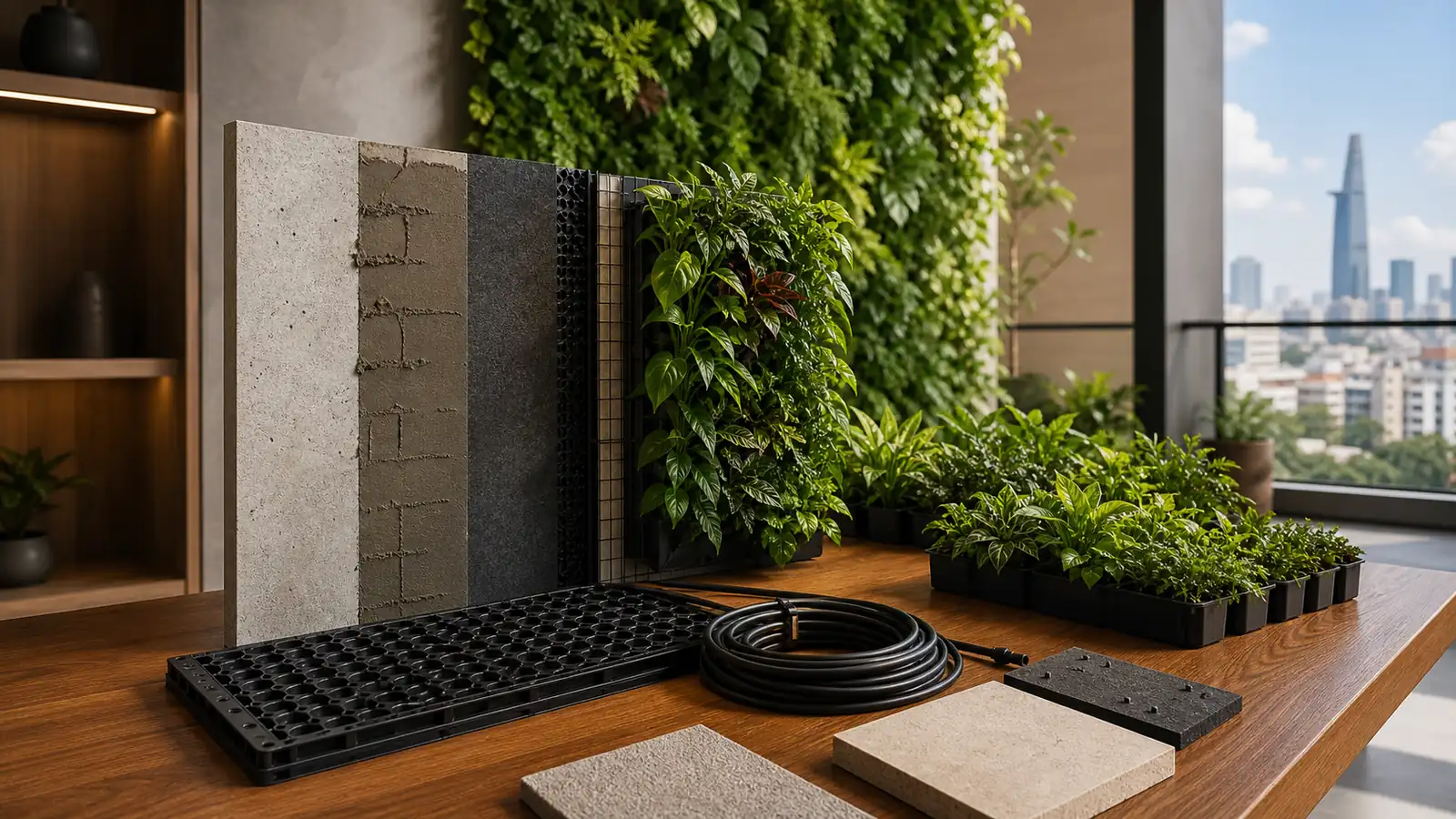
A wall behind a reception desk needs a different system from a narrow apartment balcony. The backing wall, water source, hours of light, and person responsible for care decide what sits behind the foliage. Choose a structure that the care team can operate in that exact position.
Read the Backing Wall Before Choosing Modules
Brick, concrete, drywall, and timber cladding respond differently to moisture. Where the backing is weak or sensitive to water, the installer should use a separate support structure and control the outlet. In an apartment, floor edges and nearby electrical points need attention from the first survey.
Plastic planting modules suit a wall where the technician needs to replace a local plant group and control the load. On a tall wall, removable modules reduce repair time because the full surface does not need to be opened.
Give Irrigation a Clear Water Route
Automatic irrigation reduces dependence on hand watering, but it works only when incoming water and excess water both have a controlled path. The collection tray should remain accessible rather than disappearing behind cabinetry or fixed trim.
The system needs a timer, drip emitters, and a cleaning point. Without inspection access, one blocked emitter can weaken a vertical strip of plants before the owner notices.
Read the Frame by Its Wet Load
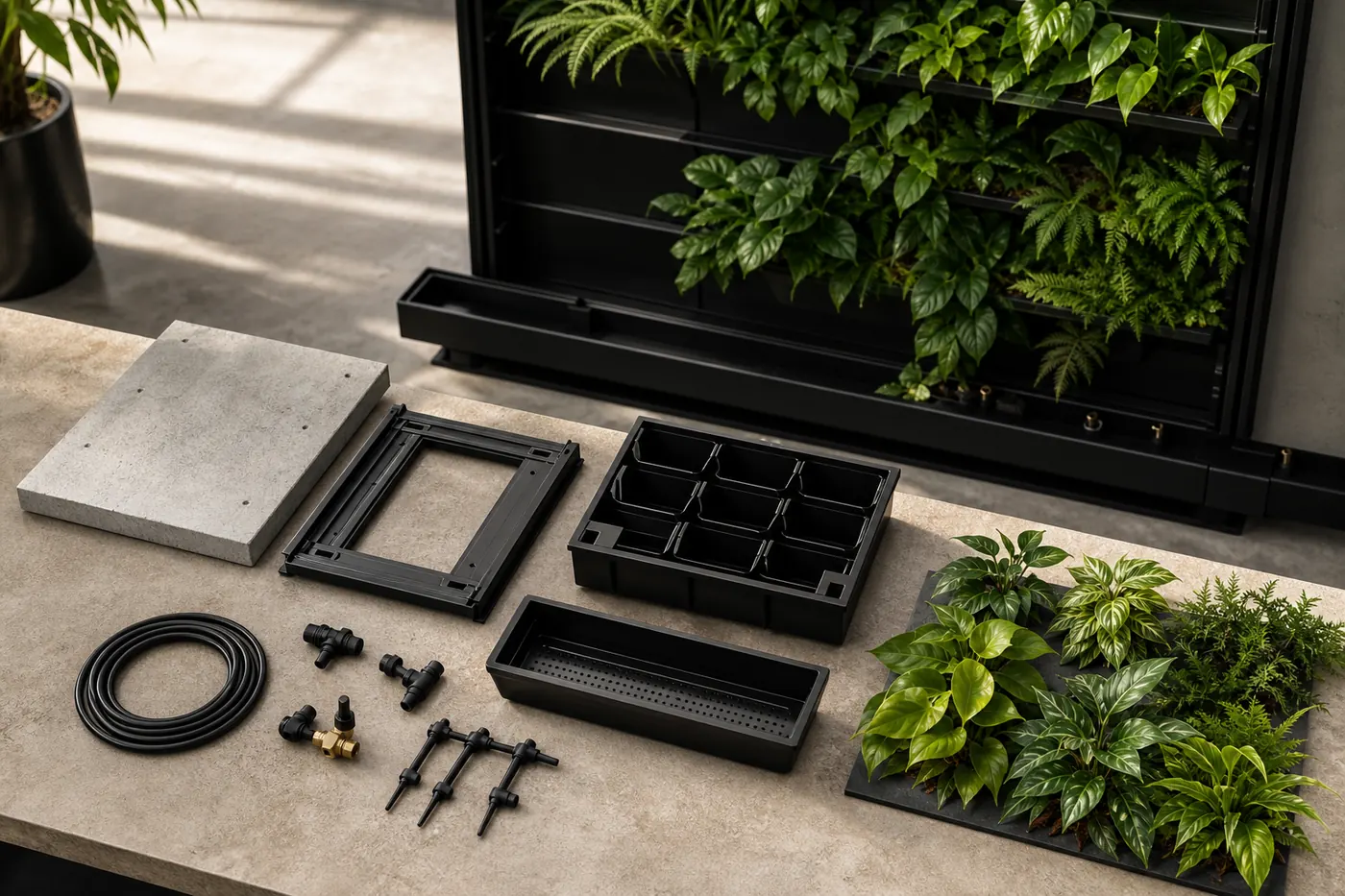
The frame carries plants, growing medium, retained water, and the force applied during maintenance. A frame that is too light may move; one that is too deep can narrow the room. On a small balcony, every centimeter affects doors, chairs, and circulation.
A useful frame lets the technician open the system, replace plants, and inspect the tray without disturbing the room.
Felt, Modules, and Installation Sequence
Felt pockets, plastic modules, and hanging pots all need a clean sequence: measure the site, prepare the backing, install the frame, test water, and add plants last. Installing foliage too early covers faults and leaves dust on the plants.
Handover should show the user the timer, outlet, signs of insufficient light, and the required care schedule.
What a Technical File Should Contain
For Tường Cây SG, a serious green wall file should show: structural assessment, waterproofing assessment, a construction section, irrigation, drainage, overflow, growing medium, plant schedule, how the system fixes to the building, and a maintenance plan. That list makes a good yardstick when comparing suppliers. Anyone who can answer all ten has done the work; anyone offering only a render has not.
Checklist Before Choosing a System
| Backing wall | Know the material, load and fixing points before choosing the system. |
|---|---|
| Water path | Plan supply, tray, outlet and inspection access after handover. |
| Plants and medium | Choose by light, system depth and moisture behavior. |
| Caretaker | Know who checks the timer, weak leaves, damp odor and replacement clusters. |
Frequently Asked Questions
Is there a green wall system that needs no care?
No living-plant system stays composed without care. The right system makes routine work lighter and repairs faster.
Does a small wall need a complex system?
Not when it is easy to reach, receives suitable light, and carries little water risk. It still needs clear drainage.
Should the system or plants be chosen first?
Choose the system from the backing wall and water route first. Select plants afterward to suit light and system depth.
What We’ve Already Worked Out
The worry: having no basis on which to compare proposals or suppliers.
What we fixed in advance: for a balcony inside the package frame, all ten items above are already fixed: dimensions, frame, modules, substrate, irrigation route, collection tray, plant schedule, and care rhythm.
Which package covers it: all three decor packages — Standard 2m² 12,500,000đ, Verdant 4m² 28,500,000đ, Evergreen 4m² 43,500,000đ.
What still needs a look: anything outside the standard balcony frame goes back to a file built around the actual site, and we quote it separately.