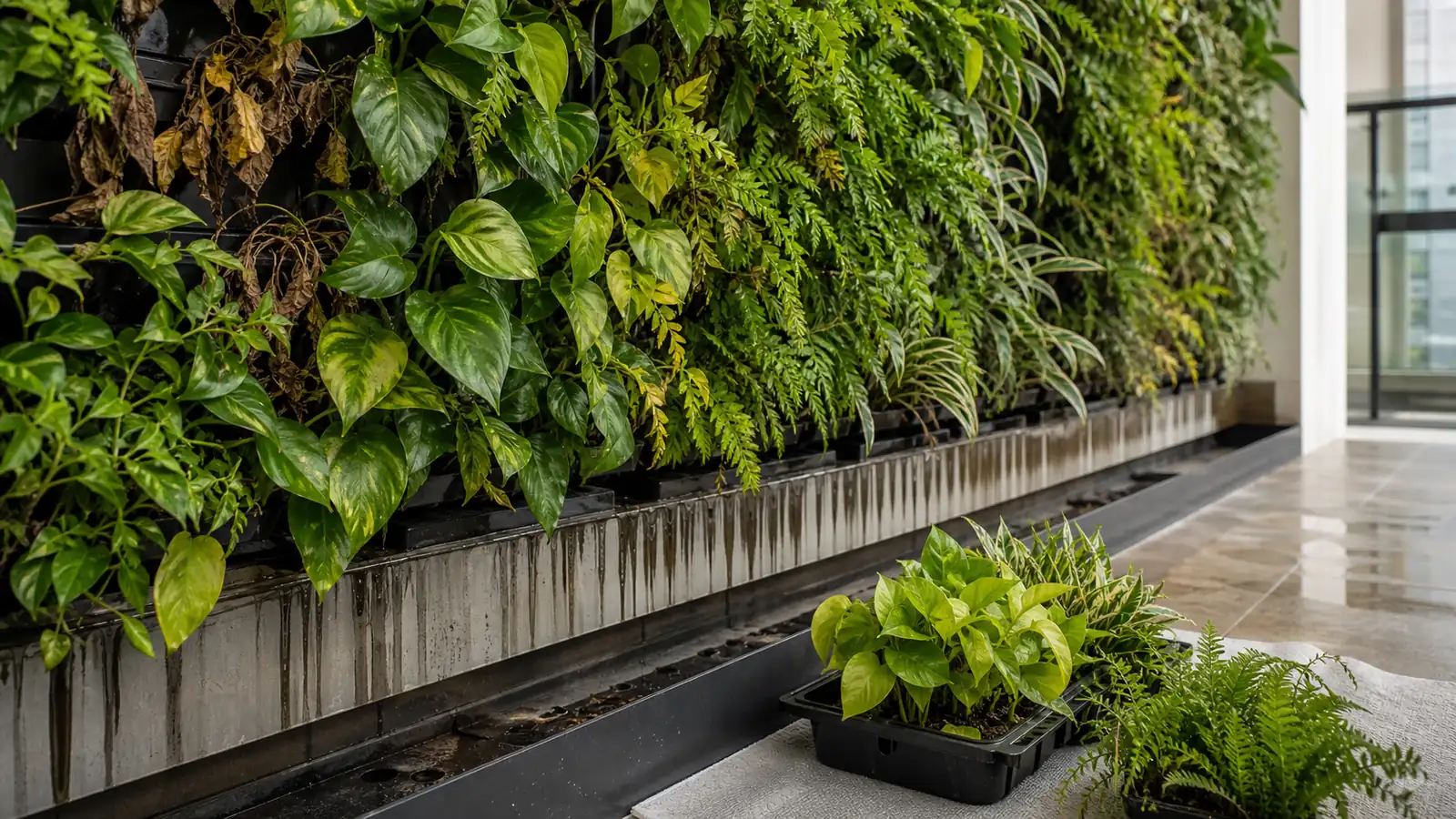
A band of yellow leaves often says more than one dead plant. It may reveal a blocked irrigation line, a dark corner, or water standing behind the modules. Find the cause by zone before removing weak plants and putting new ones into the same fault.
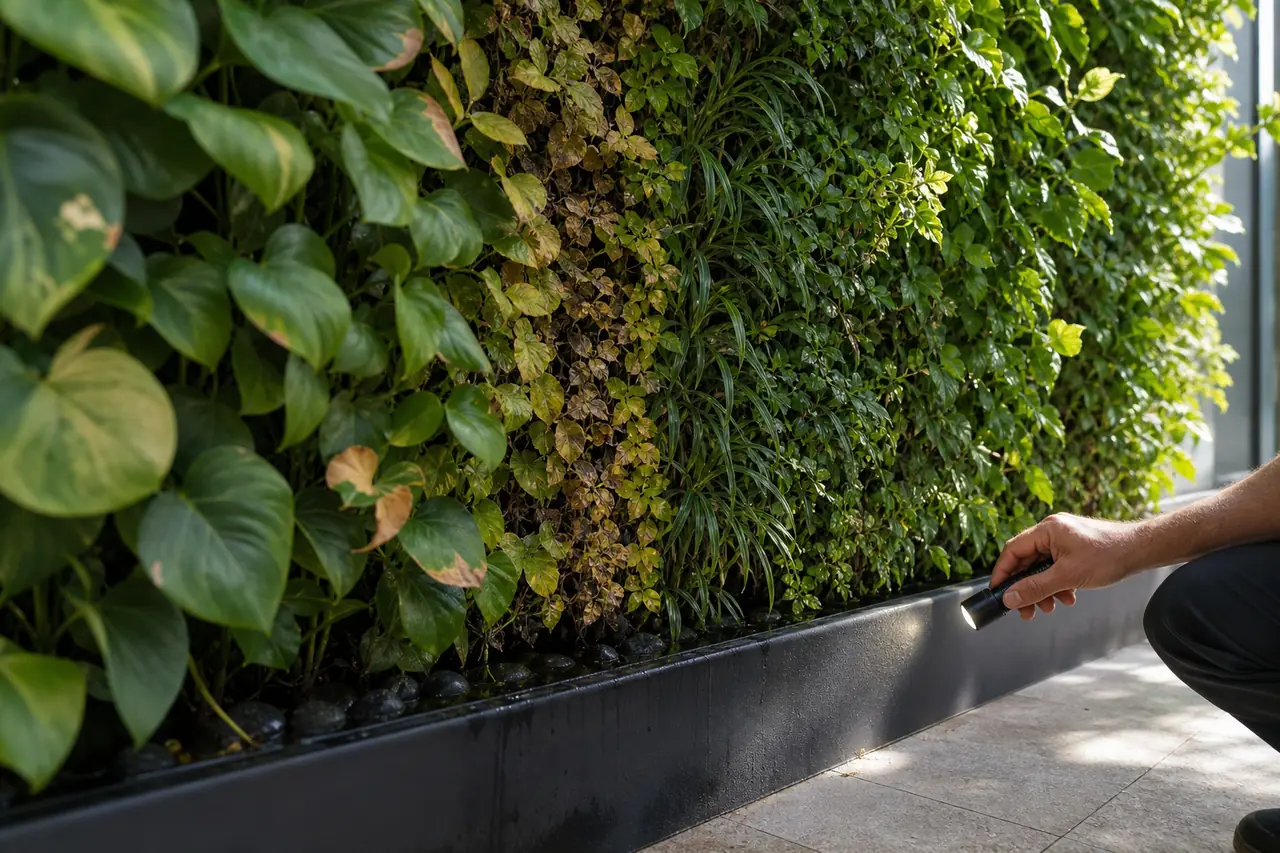
Choosing Plants for the Wrong Sun Exposure
Shade plants scorch on a west-facing balcony, while sun-loving plants stretch and lose density deep inside a living room. A reference photograph does not show the actual sun at the site.
Divide the wall into light zones. On a tall wall, the top and base may need different plant groups.
Poor Drainage and Irrigation Appear in Water Patterns
Inadequate drainage creates damp odor, damaged roots, and marks at the base. Weak irrigation makes plants wilt in bands, especially near the top or far from the supply. These faults rarely appear on handover day; they become visible after several weeks.
Test irrigation for a full cycle. A short test shows only that water arrives, not whether the tray will overflow.
Skipped Maintenance Turns a Small Fault into a Large One
Without maintenance, yellow leaves remain, emitters stay dirty, and weak plants miss the right replacement window. After several months, the wall loses density and needs work across many zones.
Routine care catches line-based faults before the full surface loses form. It costs less than rebuilding a wall after the backing has been damaged.
Incomplete Waterproofing Is Difficult to Repair
Irrigation water should not contact the backing wall. When the rear layer, collection tray, or outlet is wrong, water causes the damage, not the plants. Timber, electrical outlets, and drywall need closer protection than an open concrete balcony.
Waterproofing has to work with the support structure and drainage route. A coating alone cannot help when water remains trapped behind the planting.
The Three Most Expensive Mistakes, in Tường Cây SG’s Checklist
One: not calculating load at saturation. Tường Cây SG assesses load with the substrate fully wet and the plants mature, not from the dry module weight. Two: an undersized collection tray — it has to hold a full irrigation cycle before discharging. Three: not running irrigation before the surface closes, so foliage hides the fault and the care team has to trace it through a wall that is already dense.
Common Mistakes and What They Usually Mean
| A yellow vertical band | Suspect zone irrigation or a blockage above the band. |
|---|---|
| Scorched leaf edges | Suspect harsh sun, hot wind or plants placed in the wrong light. |
| Damp odor at the base | Suspect a dirty tray, weak outlet or water held behind the wall. |
| Replacement plants decline again | The cause remains; read water, light and medium again. |
Frequently Asked Questions
Should I add water when one area turns yellow?
Not immediately. Check light, roots, and the irrigation line first because excess water also turns leaves yellow.
Which fault is hardest to repair?
A hidden water fault behind fixed finishes. It can be corrected, but the team must open the surface and inspect the tray.
How can mistakes be reduced from the start?
Read sun direction, define drainage, divide plants by exposure, and keep a care schedule after handover.
What We’ve Already Worked Out
The worry: wanting to avoid the specific mistakes that make a wall fail within months.
What we fixed in advance: all three sit in the part we have already fixed for the balcony range: load calculated against the package dimensions, a stainless steel tray matched to the system, and every zone run before the surface closes.
Which package covers it: all three decor packages — Standard 2m² 12,500,000đ, Verdant 4m² 28,500,000đ, Evergreen 4m² 43,500,000đ, each with automatic irrigation, a collection tray, and a 12-month irrigation warranty.
What still needs a look: a west-facing balcony under hard afternoon sun needs a different plant list within the same concept. That changes the plants, not the package price.